Thursday, July 22, 2010

Water-base Vs. Oil-Base Stains

Water-based wood stains share many of the same virtues of latex paints and other water-based wood finishes: low odor, easy clean-up without harsh solvents, and relatively fast drying. You’ll also find a wider range of color choices that includes not only wood tones but also blue, green, red, and yellow. If you are following up with a water-based clear polyurethane or similar topcoat finish, the compatibility of the two products also helps. With some of those properties, however, come a few drawbacks. First, the water swells and raises the wood grain at the surface, creating a rougher texture that may have to be re-sanded. Also, water-based stains tend to set the color (pigment) faster; you have to keep working a wet edge and wipe off the excess stain immediately so you don’t get lap marks. On big surfaces, that pace can be difficult to manage unless you have a helper. Or use a gel-type water-based stain, which can give you more working time.

Traditional oil-based wood stains often have the same type of pigment, but the oil layer keeps the particles in suspension longer and affords you more time to apply the stain and wipe down the wood surface without getting lap marks or streaks. But the solvent fumes (from the volatile organic compounds, or VOC) require good ventilation and are environmentally harmful. Drying time is slower, because although the solvents evaporate quickly the oil still has to cure through exposure to oxygen. That often means waiting 24 hours to apply a clear topcoat, especially a water-based finish. Oil-based stains and finishes tend to yield an amber or yellowish tone that increases with age, great for the warm look of traditional furniture, but for some contemporary designs the neutral or clear look of water-based stains and finishes is a better choice.

With either category of product, it’s always best to experiment on some scrap stock leftover from your project. Each combination of stain and clear finish will produce a slightly different look; try out a few options so you don’t get an unwelcome surprise on your project.

Thursday, July 15, 2010

Using a router to cut dadoes and rabbets

The most basic kinds of woodworking can happen with little more than a handsaw, hammer, nails, and glue, but the core of the craft is joinery. Making specialized cuts and contours in wood surfaces lets you join parts more accurately and create a much stronger result, but it takes more tools and techniques to step up to that level. Traditional hand tools still get the job done, though they require an investment of time and skills that isn’t an option for every woodworker today.

Outfitting your shop with a table saw will, in one step, bring a new dimension of versatility and accuracy to your woodworking efforts, and it’s probably the best first investment in power machinery. But don’t overlook portable power tools, especially routers. These small powerhouses spin a wide range of interchangeable cutters (called bits) at high speeds, letting you mill decorative edges as well as cut precise joinery such as rabbets, dadoes, and dovetails.

Cross-grain dadoes can be cut by aligning a jig or straightedge guide with your layout marking and clamping it in place. A dado is nothing more than a flat-bottom groove machined to accept another part, such as a shelf or a stiffening brace. Straight-cut router bits are sold in common fractional widths (1/4, 1/2, 3/4-inch, and so on) and so with a single pass can cut shallow and precise dadoes; for deeper or wider dadoes, you can make multiple passes.

The particular mechanics of a router cut mean that tearout and splintering are often far less problematic than when making a similar cut with a circular saw blade. Better still, the bottom face of the groove is smooth and flat, resulting in a better glue bond when you fit a mating part into place. But this technique illustrates one of the common requirements of router use: having a guide board, jig, or template to control the router base so the cutter doesn’t drift randomly off-course.

Some router bits feature built-in guide bearings that ride against the edge of a workpiece and cut away a portion of that edge. Many of these are decorative bits that cut curved profiles, but a rabbeting bit is different. A rabbet is an L-shape notch cut along the edge of a workpiece, again to make room for another part that will nest there. The size can be varied by using different bit and bearing diameters, and the depth adjustment is provided via the router base; typically the cut is made in several lighter passes rather than one heavy cut. This produces less strain on the cutter and the router motor, and typically yields a cleaner cut on the workpiece.

The same straight cutters used for dadoes can also cut rabbets, but an edge guide or other accessory must be used to control the cutter path so it cuts straight along the edge as desired.

Thursday, July 8, 2010

Cutting Miters and Bevels

Thanks to the versatility of table saws and power miter saws, making angled cuts requires only making some simple adjustments, not switching to another specialized tool or machine. That said, the cutting dynamics do change some when the blade or workpiece angle varies from a basic 90-degree cut, and this requires some different techniques.

When you’re making a standard rip cut or crosscut, you’re feeding the workpiece against the cutting teeth (or vice versa) with direct support to counteract and help control the cutting force generated by the spinning blade. Otherwise, that force would launch the workpiece like a projectile rather than cut through it. Angled settings add the likelihood of deflection because support of the workpiece isn’t as directly opposed to the cutting pressure. Working safely and accurately involves making sure the workpiece doesn’t shift out of alignment during the cut, and techniques for accomplishing that depend on the tool you’re using.

Table saw

Angled crosscuts on the table saw typically require using the miter gauge. The sharper the angle, the more the workpiece will want to slide against the face of the miter gauge. The most reliable ways to prevent this are to apply adhesive-backed sandpaper to the miter gauge face, attach a sacrificial backer board to the miter gauge and fit it with a stop block, or clamp the workpiece to the miter gauge if the tool’s design allows it. Better still, make a shop-built crosscut “sled” with an adjustable angle guide. Any of these measures is usually enough to prevent the “creep” that can occur when making a miter cut or a compound angle (bevel and miter together) on the table saw. Incidentally, don’t trust the accuracy of the angle scales on the saw or miter gauge—make a trial cut and check it.

Beveled rip cuts introduce another key consideration—keeping the workpiece flat on the table. Most table saw blades tilt to the right, toward the rip fence, creating the possibility that the workpiece might bind during the cut. Applying pressure to keep the stock flat on the table helps reduce the chances of binding and/or burning the edge, but take extra care to keep your fingers clear of the blade. When possible, consider repositioning the rip fence to the left side of the table, so the blade tilts away from the fence, the workpiece, and your hands.

Circular saw

Using a handheld circular saw for angled cuts requires the same techniques and accessory guides you’d normally use. For simple miter cuts, you can use an angle square or a shop-built jig as a guide; clamp the guide to the workpiece so you can keep your fingers a safe distance from the blade. For beveled cuts, use the adjustment feature on the saw’s base, but again, don’t trust the scale; make a trial cut and check it. Remember that the maximum cutting depth decreases as the angle increases.

Miter saw

Miter saws are designed to excel at angled cuts, so they don’t really require specialized techniques or accessories. The center table pivots for miter cuts, and on compound miter saws, the motor assembly swivels down to make bevel cuts also. One factor is especially critical: first, make certain the workpiece is held securely against the table and fence. You can do this with hand pressure or with a clamp; many saws feature a removable clamp standard or as an optional accessory. Steeply angled cuts, especially compound angle cuts, can bring the blade dangerously close to your fingers if you are holding the stock manually. In that case, secure the workpiece with clamps instead.

Friday, June 25, 2010

Know The Surfaces Of A Board

There are distinctive names for the surfaces of a board and it’s important to know what they are, especially when it comes to reading project instructions. References are made to these surfaces for specific cuts and when joining project parts.


Board Surfaces


Face: The faces are the two widest surfaces of a board. On a 1 x 3, for example, the face measures 2 1/2 inches wide.

Edge: The edges of a board are perpendicular to the faces and run the length of the board. On a 1 x 3 x 4, the edges measure 3/4 x 4 feet.

End: The ends of a board are pretty self-explanatory. They are perpendicular to the faces and run the width of a board. On a 1 x 3, the faces measure 3/4 x 2 1/2.


Bevels & Miters

Knowing these terms is essential when cutting bevels and miters.

  • A bevel is and angled cut across the edge of a board from face to face.


  • A miter is an angled cut across the face of a board from edge to edge.


  • A compound miter is a combination of both a bevel and a miter cut.


During assembly of this frame, the ends of the miters are joined.


During the assembly of this frame, the ends of the bevels are joined.


Monday, June 14, 2010

Stain On Lumber Other Than Oak

There’s no hard-and-fast rule that says you can’t substitute pine, poplar, or any of a number of other woods for oak. In fact, some other wood species might be a better choice for certain projects.

First, let’s take a quick look at what red oak (the most common variety for lumber) has to offer. It’s dense, strong, machines well, and has the pronounced grain pattern or figure common to ring-porous hardwoods. Those pores and patterns are what give oak its distinctive look, which staining accentuates even further. Depending on their original orientation of the growth rings in the board, oak can have a prominent arch or “cathedral” pattern or a straight grain (rift) or flecked (quartersawn) pattern. And while it has a naturally pink or light reddish cast, it takes stain colors readily and uniformly and so can offer a lot of versatility when it comes to color. You can get a nice light golden color or push it to a deep brown, or even use aniline dyes to make it bright red, yellow, blue, or green.

Pine and poplar are less expensive alternates and can work fine for many projects, though typically they don’t take stain as consistently as red oak does. Like other conifers (softwoods), pine has a sometimes unruly grain and contains resin concentrations or pitch pockets that can interfere with stain absorption. You can get blotchy coloring if you don’t use a stain conditioner beforehand. Also, it’s softer and dents more easily than oak, though the lighter weight can be a plus.

Like oak, poplar is a hardwood but it isn’t as dense or strong, nor does it machine as cleanly. The softer close-grained fibers sometimes yield a fuzzy surface that makes stain colors look muddy, and some boards have streaks of yellow, green, or brown that can’t be masked easily. The grain patterns are much more subdued than with oak, which can be an advantage if you want to accentuate just the color and not have pronounced figure.

Thursday, June 10, 2010

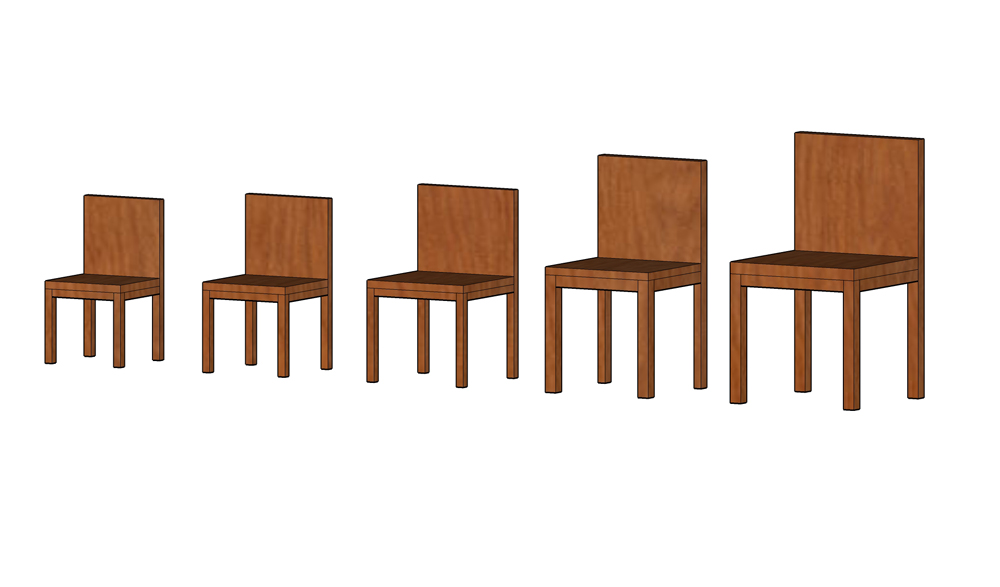
Sizing Furniture

Not every one is the same size, but furniture typically is.

For example, the height and width of the seat of a kitchen or dining chair is usually around 18 inches, and the back ranges from 30 to 48 inches high. A kitchen or dining table is about 30 inches high.

Of course, there are plenty of variances in sizes of what you may find in your home or in furniture stores, but these figures are good basic guideline dimensions that can get you started when planning to build a set of chairs and table.

However, if you are looking to build a table and chair set for children of specific ages, you might want to consider this list of sizes for chairs and tables for various age ranges.

Age 5-6

Chair

Seat height: 10 1/2 inches

Seat width: 11 inches

Back height: 20 1/2 inches

Table

Height: 17 1/2 inches

Age 7-8

Chair

Seat height: 11 1/2 inches

Seat width: 12 inches

Back height: 21 3/4 inches

Table

Height: 19 inches

Age 9-11

Chair

Seat height: 13 inches

Seat width: 14 inches

Back height: 24 inches

Table

Height: 20 3/4 inches

Age 12-15

Chair

Seat height: 16 inches

Seat width: 15 inches

Back height: 29 inches

Table

Height: 25 1/2 inches

We all know that not every 9 year old is the same size, and of course, kids grow quickly. So if you make furniture for your children or grandchildren, it’d be best to size the pieces to last through a broad range of ages.

And certainly, if you’re building furniture for a setting that will have a consistent age range year in and year out, such as a playroom at a church, size them for specific ages.

Thursday, June 3, 2010

Simplified Drawer Construction

Drawer box sizes are determined by the drawer opening in the face frame, the depth of the carcass, and the drawer slide hardware used.

When laying out the face frame for your project it will look better using “graded drawer sizes”. Starting with shortest drawer at the top and increasing the height of the drawer as you move down the face frame.

The drawer sides are usually 1/2- to 1-inch shorter than the drawer opening up to a maximum of 8-inches high. There are exceptions in height, such as file drawers and special purpose drawers.

The depth of the carcass determines the maximum length of the drawer. My preference is 18- to 20-inches in length. The usual extension of an open drawer is around 16-inches, and a 22-inch long drawer is just 6 more inches of clutter.

Selecting the drawer slides:

Center Mount Drawer Slide

The center mount drawer slides are mounted under the center of the drawer.

These are the lightest duty 35-50 pound rating, which is usually adequate for residential needs.

The advantages of this type of slide, is that it is usually invisible when the drawer is open, and the drawer is wider than those with side mount slides. The cost is less than heavy-duty slides.

When installing center mount slides, install a 1 x 4 along the vertical centerline of the drawers, especially if the cabinet has a 1/4-inch back. This gives more material for the back plate hardware to be secured to.

Side Mount Drawer Slide

These are usually medium to heavy-duty slides 60- to over 100-pound rated. Some are especially designed for the Euro-style cabinets (frameless). They can be epoxy-coated with nylon bearings.

Example 1: Building a Traditional drawer box

There are many ways to build drawers and a whole book could be written on the subject. I even read an article once about hand cutting blind (invisible) dovetail joints, just in case someone repairing the joint two hundred years from now would be impressed with the craftsmanship of the builder, and it was beautiful craftsmanship. If I’m going to hand cut dovetail joints I want to see them.

These instructions will only cover two ways, the traditional drawer box and a simplified box.

Side / front / back assembly.

a. The drawer sides, front, and back are usually 1/2-inch thick. You can use just 1/2-inch plywood for a utility or shop drawer. For a nicer drawer you can use 1/2-inch plywood with the exposed top banded with solid stock. For the nicest pieces

Lowe’s has stock already sized to 1/2-inch thick.

b. Rip enough stock for the (01) drawer sides and the (02) drawer box fronts to the height desired. It is easier to rip all of the stock to the tallest side that you will be building. It saves set up time to rip them back down after making the grooves in the sides and the drawer box fronts.

c. Using a 1/4-inch dado blade or a 1/4-inch straight cut router bit, starting 1/4-inch from one long edge cut a 1/4-inch wide x 5/16-inch deep groove into the ripped stock as shown in Example 1.

d. The length of the (02) drawer box front equals the drawer opening less the space for the drawer slides (see manufacturers directions) less the thickness of the two (01) drawer sides. I usually add 1/16-inch extra. When using side mount slides, if there is an error and the drawers don’t slide smoothly it is much easier to shim behind the drawer slide than it is to remove material from the (01) drawer sides.

e. Using a squaring jig, glue and nail the (01) drawer sides to each end of the (02) drawer box front.

f. To determine the size of the (03) drawer box back. The length will be the same as the (02) drawer box front. The height will be from the top of the groove in the (01) drawer side to the top of the (01) drawer side. The (03) drawer box back will be installed flushing the ends of the (01) drawer sides and flushing the top of the (01) drawer sides using glue and nails.

Add the bottom.

a. To determine the size of the 1/4-inch plywood (04) drawer bottom. The length will be the length of the (01) drawer side less 1/4-inch. The width will be equal to the width of the drawer box assembly less 1/2-inch.

b. In the past when there were wood boards wide enough to make 18- to 30-inch-wide drawers the bottom was left to “float” in the grooves to allow for expansion and contraction. Since plywood is stable and has very little movement I like to apply a bead of hot melt glue to the junction of the groove and the bottom. The hot melt glue is flexible enough to allow any movement that might occur, yet strong enough to keep the drawer square. Apply the hot melt glue with the drawer clamped into the squaring jig.

Build the Simplified Drawer Box.

a. The sides, drawer box front, and the drawer box back will be the same height with no grooves. The sizes will be determined by the same rules that apply to the traditional drawer box.

b. Rip the stock for the sides, front and back to the desired width.

c. In a squaring jig assemble the four pieces as shown in Example 2.

d. Cut the 1/4-inch plywood bottom to match the width and length of the side/ends assembly. Clamp the assembly into the squaring jig. Using glue and attach the bottom to the side/end assembly.

e. This type of drawer is useful in shop applications when you don’t have heavy loads in the drawer, or in utility storage areas. It’s quick, easy and when side mount slides are used, the plywood edges are barely seen.